Host or moderator for a business event: who to choose in 2026 so the program does not fall apart
May 6, 2026
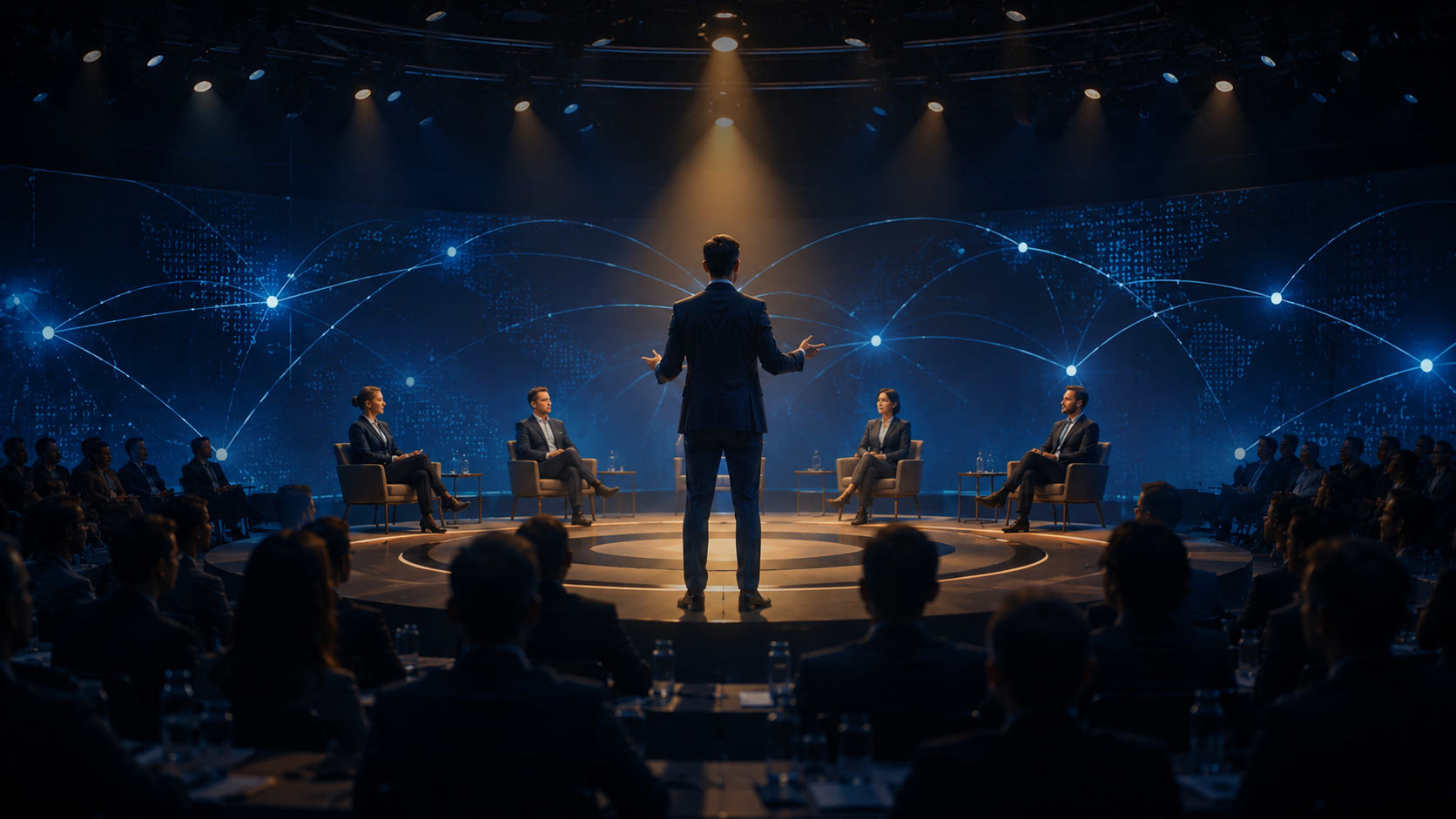
A practical deep-dive for organizers of conferences, forums, and corporate business sessions: roles, common mistakes, checklists, timing, and selection criteria.
How to choose between a host and a moderator for a business event: key differences, responsibilities, common mistakes, selection checklist, and preparation workflow.
A business event needs someone who can manage more than the microphone. If your agenda includes panel discussions, strategic sessions, audience questions, C-level guests, partner integrations, or a complex topic, you need a professional business moderator, not only a stage host.
A host helps the event move through the script: introduces segments, presents speakers, maintains rhythm, fills pauses, and supports the atmosphere. A moderator works deeper: studies the subject, prepares the logic of the discussion, works with speakers before the event, manages the conversation in real time, and helps the audience arrive at clear conclusions.
Many business events lose quality because organizers think about the person on stage too late. The venue is booked, the program is almost approved, sponsors are confirmed, speakers are invited, and then someone asks: "Who will introduce everyone?" At that point, the most valuable opportunity is already reduced. A moderator can truly strengthen the program only when brought into the content early.
Why the person on stage affects the event outcome
A business event is judged not only by lighting, registration, and coffee breaks. Participants remember whether the content was useful, whether strong ideas emerged, whether new relationships started, whether there were actionable questions, and whether they would attend again.
The person on stage becomes the interface between the organizer, speakers, partners, and audience. Through that person, participants read the event level: professional, chaotic, lively, stretched, premium, superficial, or genuinely useful.
Weak stage management creates familiar problems:
- speakers repeat the same points;
- a panel turns into a sequence of mini-presentations;
- audience questions drift away from the topic;
- timing collapses after the first segment;
- participants move into their phones;
- partners do not get meaningful contact with the audience;
- the organizer gets a good-looking event with weak content impact.
A strong moderator turns the program into one coherent line: frames the discussion, holds attention, helps speakers stay relevant, involves the audience, and closes each block with a clear takeaway.
How a host differs from a moderator at a business event
The difference lies in three areas: preparation depth, responsibility for content, and independence in the moment.
A host usually works with an approved script. Their responsibility is energy, transitions, announcements, speaker introductions, program rhythm, and the overall atmosphere. This role is important for ceremonies, openings, awards, gala dinners, corporate events, and formats where speakers present sequentially without discussion.
A moderator works with the content. They need to understand why the session exists, what its goals are, who is in the room, why these speakers were invited, where positions may differ, and what the audience should understand after the conversation.
Criterion Host Moderator Main task Run the program according to the script Manage content and discussion Preparation Studies the script, names, timing, format Studies the topic, goals, speakers, audience Work with speakers Introduces and hands over the floor Prepares questions, removes overlaps, manages dynamics Work with audience Supports contact and atmosphere Involves the audience and manages questions Reaction to disruption Smooths the pause or returns to the script Rebuilds the session flow without losing the goal Session ending Closes the segment and announces the next one Formulates conclusions, meaning, and next steps
When a host is enough
A host is a strong choice for events where the main task is to guide participants through the program without content complexity. This includes conference openings, award ceremonies, brand presentations, corporate events, evening parts of forums, formal segments, or formats where speakers perform one after another and do not enter a discussion.
A host is enough when:
- the program is linear and fully scripted;
- the focus is atmosphere, status, and pace;
- there is no complex panel discussion;
- speakers are experienced and self-sufficient;
- no shared decision or content conclusion is required;
- the audience does not expect deep expert analysis.
A good host makes an event structured, easy to follow, and professional. But when a complex idea, several strong positions, and a real discussion appear in the program, stage confidence alone is no longer enough.
When you need a moderator
A moderator is needed when an event must produce intellectual, communication, or business results. The higher the audience level, the more expensive participants' time, and the more complex the topic, the higher the cost of weak moderation.
A moderator is especially important for:
- panel discussions;
- strategic sessions;
- industry forums;
- closed C-level meetings;
- partner business breakfasts;
- sessions with public, corporate, or expert stakeholders;
- brainstorms and facilitation formats;
- conferences where takeaways, relationships, and follow-up deals matter.
In such formats, the moderator becomes the meaning navigator. They help participants avoid drowning in speeches and see the full picture: the problem, the positions, the tension, the possible solutions, and what can be applied after the event.
What a moderator does before the event
Strong moderation begins long before stepping on stage. If a moderator first sees speaker materials the day before the event, they may hold the format, but they are unlikely to strengthen the content deeply.
During preparation, a moderator helps the organizer solve several tasks.
1. Clarify the session goal
"Let’s talk about trends" is usually too broad. A moderator helps narrow the frame: what participants should understand, which questions must be explored, and what conclusion the discussion should lead to.
Weak frame: "We will discuss the future of the industry." Strong frame: "We will examine which three industry shifts are already affecting budgets, teams, and customer expectations over the next 12 months."
2. Analyze the speaker lineup
Every speaker has a strength: experience, status, case, expertise, position, or access to data. The moderator understands in advance whom to ask about what, where speakers can complement each other, and where it may be useful to show differences in perspective.
3. Remove overlaps and empty spaces
Business events often have five strong people saying almost the same thing in different words. The participant hears repetition, loses attention, and starts perceiving the program as stretched. A moderator helps distribute accents so that each speaker adds a new layer.
4. Prepare questions and scenario branches
A good question helps a speaker open up. A weak question invites general statements. A moderator prepares not only the main list of questions but also backup options: what to ask if a speaker speaks too long, if the audience stays silent, if tension appears, or if one panelist dominates.
5. Align the rules of the game
Before the event, speakers should understand timing, speaking logic, answer format, audience Q&A rules, and final takeaways. This lowers the risk of conflicts on stage and helps everyone look professional.
What a moderator does during the event
On stage, a moderator manages several processes at once: time, meaning, energy, people, audience, script, and unexpected situations. It may look easy from the outside, but internally it is constant work with attention and dynamics.
Maintains focus
If the session is announced as "B2B marketing efficiency" and the conversation drifts into personal stories, the moderator brings it back to the main question. They do this respectfully but firmly.
Manages timing
Timing in a business program is more than a technical detail. If the first speaker takes 12 extra minutes, later participants lose their opportunity to speak, and the audience loses trust in the event. A moderator protects timing without destroying the content.
Helps speakers become clearer
Some experts are strong in their subject but do not always speak briefly or clearly. A moderator helps them turn a thought into something useful for the audience: asks for an example, clarifies the point, or translates a complex term into a practical takeaway.
Involves the audience
High-quality audience questions rarely appear automatically. They need to be launched, collected, filtered, grouped, and sometimes reformulated. A moderator makes sure the audience is not passive.
Controls chaos and tension
A strong business session can include different positions. That is valuable. But the tension should serve the topic, not personal competition. A moderator keeps the conversation respectful and productive.
Formulates the conclusion
The ending should leave participants with a sense of completion. Not everyone has to agree. But the audience should understand which conclusions were voiced, what matters, and what can be done next.
Why a "charismatic person" can damage a business program
Charisma helps hold attention, but it is not enough for a business event. In fact, the wrong kind of charisma can hurt: excessive jokes, theatrical behavior, misplaced familiarity, or attempts to "warm up the room" in a corporate-party style often conflict with the expectations of a mature business audience.
Business events require relevance. Relevance in humor, pace, language, addressing speakers, reacting to the audience, and understanding participant status. This is especially important when the room includes executives, partners, investors, public stakeholders, or major clients.
An organizer’s mistake often sounds like this: "They host big events well, so they will handle it." Maybe. But business moderation requires another lens. It is not only about speaking beautifully; it is about thinking with the audience.
Common mistakes organizers make
Mistake 1. Looking for the person too late
A moderator needs time to prepare. The more complex the topic, the earlier they should be involved. Searching one week before a forum almost always means surface-level work.
Mistake 2. Providing no proper brief
"Everything is on our website" does not replace a brief. A moderator needs event goals, audience profile, partner expectations, speaker list, sensitive topics, risks, interaction format, and success criteria.
Mistake 3. Mixing roles without a scenario
One person can be both host and moderator, but role switching should be designed in advance. A conference opening, a business panel, and an evening ceremony require different energy.
Mistake 4. Judging only by voice and stage presence
A video from a bright stage shows only part of the picture. You need to see how the person asks questions, handles long answers, reacts to unexpected situations, and keeps the meaning line.
Mistake 5. Not agreeing on authority boundaries
A moderator should know whether they can shorten answers, change question order, address the audience, interrupt a monologue, move away from a sensitive topic, or ask for specifics. Without these agreements, they become trapped by the script.
How to choose a moderator for a business event
Start with the goal of the event, not with the question "who is available on the date?" Different formats require different profiles.
Event format Moderator profile What to evaluate Industry conference Fast immersion into the market and strong work with experts Question quality, terminology, ability to connect themes Panel discussion Ability to manage different positions Handling monologues, managing tension, creating clear takeaways C-level meeting Calm, premium, content-strong moderator Relevance, business language, respect for participants' time Strategic session Facilitation skills Discussion structure, decision capture, group dynamics Partner breakfast Ability to connect business content and networking Subtle audience work, questions, transition into contacts Award ceremony Host or host-moderator hybrid Stage confidence, pace, status awareness, atmosphere
Questions to ask a moderator before hiring
An interview with a moderator should not be limited to "What is your fee and are you available?" You need to check their preparation approach and thinking.
These questions help separate a strong candidate from a random one:
- "How do you prepare for a topic that is new to you?"
- "Do you run pre-session calls with speakers?"
- "How do you handle a panelist who talks too much?"
- "What do you do if the audience does not ask questions?"
- "How do you capture the conclusion of a discussion?"
- "What materials do you need from the organizer?"
- "How do you adapt tone of voice to the event brand?"
- "What would you do if the program is 20 minutes behind schedule?"
- "Can you show a video of a real business discussion, not only a ceremony?"
A strong moderator answers with examples, structure, and scenarios. A weak candidate often uses general phrases: "I feel the room", "We will see on site", "Energy is the main thing". Energy matters, but without method it will not save a complex program.
When to start looking for a moderator
Start looking when the event has a basic framework: goal, audience, main topics, preliminary speaker list, or at least a clear understanding of formats. For large events, this may be several months in advance. For a closed business session, allow at least several weeks.
Event type When to start Why Large industry forum 3-6 months before Program, speakers, partner segments, and risks must be aligned Conference for 200-500 people 2-4 months before There is time for briefing, question preparation, and speaker work Closed C-level meeting 6-10 weeks before Tone, status, confidentiality, and wording accuracy matter Corporate strategic session 4-8 weeks before The company context and discussion structure must be understood Small business breakfast 3-5 weeks before Enough time for program, questions, and participant networking design The earlier the moderator is involved, the more likely the program will be built around the goal rather than around a random sequence of speeches.
What a good moderator brief includes
A brief saves time for everyone involved. It helps the moderator work with a precise task instead of guessing expectations.
A strong brief should include:
- event goal;
- goal of each session;
- audience profile;
- speaker list and their roles;
- organizer expectations;
- partner and sponsor interests;
- sensitive topics;
- phrases or accents to avoid;
- timing and technical script;
- rules for audience questions;
- success criteria after the event.
The minimum preparation question: "What should change in the participant’s mind or behavior after this session?"
Mini case 1: strong speakers, weak panel
Initial situation: the organizer gathered well-known experts for a panel discussion. Each speaker was interesting individually, but previous experience showed that such panels often turn into separate monologues.
What changed:
- short pre-calls were held with speakers;
- main talking points were collected and overlaps identified;
- the conversation was divided into four rounds with different focus areas;
- each speaker received a topic where they could contribute best;
- backup questions were prepared for general or vague answers;
- each speaker was asked to give one practical takeaway at the end.
Result: the panel became a coherent conversation instead of four short speeches in a row. Participants received different perspectives, clear takeaways, and reasons for follow-up conversations.
Mini case 2: a business breakfast that needed to connect people
Initial situation: a company held a closed breakfast for clients and partners. The room had strong participants, but many did not know each other. The risk was clear: people would listen to the speaker, drink coffee, and leave without new relationships.
What worked:
- the moderator received the participant list and their interests in advance;
- the opening was built around a shared topic relevant to everyone;
- after a short expert segment, structured mini-introductions were launched;
- participants used a simple frame: who you are, what task you came with, whom you are looking for;
- the moderator connected people with similar tasks in real time;
- the organizer received a list of follow-up contacts after the meeting.
Result: the event became a relationship tool instead of a morning lecture. Participants left with new contacts, and the company strengthened its position as the organizer of a useful business environment.
Mini case 3: a strategic session with many voices and no decisions
Initial situation: a top team gathered to discuss a direction’s development. In previous sessions, the conversation turned into department-level defense, and final decisions remained vague.
What changed:
- three main questions were aligned with the owner and executives before the session;
- the discussion was divided into blocks: facts, hypotheses, solution options, ownership;
- time limits were introduced for contributions;
- disputed issues were parked separately to protect the main flow;
- decisions were captured in real time on a shared screen.
Result: the team left not with a feeling of "we talked", but with decisions, owners, and deadlines. Moderation preserved the useful energy of debate and directed it toward outcomes.
Which KPIs can be set for moderation
Moderation quality can be evaluated not only by feelings. For a business event, it is useful to define 5-7 criteria in advance.
- sessions finished on time;
- speakers covered different aspects of the topic;
- the audience asked relevant questions;
- participants stayed until the end of key sessions;
- follow-up meetings appeared after the session;
- content NPS was high;
- the organizer received clear takeaways and materials for post-event communication.
If these criteria are not defined, moderation is evaluated too subjectively: "we liked it" or "we did not like it". For a serious event, that is not enough.
How to know that real moderation is happening
You can recognize real moderation by the quality of the conversation. Speakers do not compete for the microphone; they complement each other. Questions become sharper. The audience understands why the discussion is happening. Transitions between blocks feel natural. Conclusions appear as the result of a managed logic, not by accident.
Several signs:
- the moderator asks questions that cannot be answered with generic phrases;
- handles long answers respectfully but firmly;
- highlights contradictions without unnecessary conflict;
- translates expert language into practical takeaways;
- notices audience fatigue and reacts to it;
- remembers the session goal even while improvising;
- closes the block so participants understand why it mattered.
Organizer’s final checklist
- Define the goal of the event and each key session.
- Separate roles: where you need a host, a moderator, or a hybrid.
- Bring the moderator in before the program is fully approved.
- Prepare the brief: audience, goals, speakers, risks, timing, tone of voice.
- Plan pre-calls with speakers.
- Agree on rules: timing, questions, interventions, final takeaways.
- Review the candidate’s video from business sessions.
- Evaluate not only voice and stage presence but thinking, questions, and response to complexity.
- Prepare plan B for delays, cancellations, technical issues, and audience silence.
- After the event, collect feedback on content quality, dynamics, and usefulness.
FAQ
Who should lead a business event: a host or a moderator?
It depends on the event goal. A host is enough for ceremonies, openings, awards, and linear programs. A moderator is better for panel discussions, strategic sessions, forums, and C-level meetings where content and discussion quality matter.
Can one person be both host and moderator?
Yes, if the person has both skill sets and the organizer designs role switching in advance. An opening, business panel, and evening segment require different pace, language, and level of intervention.
When should we start looking for a conference moderator?
Start when the goal, audience, main topics, and preliminary speaker list are clear. For a large forum, that may be 3-6 months in advance; for an industry conference, 2-4 months; for a closed business session, 4-8 weeks.
What materials does a moderator need for preparation?
A moderator needs the event goal, session goal, audience profile, speaker list, presentation topics, partner expectations, sensitive issues, timing, technical script, and success criteria. The more precise the brief, the stronger the moderation.
How can we check whether a moderator fits a business audience?
Ask for video from a real business discussion, then ask about preparation, speaker work, timing management, and handling difficult situations. Evaluate not only stage presence but also question quality.
What matters more for a moderator: subject expertise or stage skills?
You need balance. For complex topics, the ability to quickly understand the content, speak the audience’s language, and ask precise questions is critical. For public formats, stage stability, voice, pace, and audience energy also matter.
Why should we avoid looking for a moderator at the last minute?
Strong moderation requires preparation: brief, topic research, speaker work, scenario branches, and questions. With late involvement, a person can run the program, but it is much harder to strengthen the content.
Summary
For a business event, choose the person on stage based on the event goal, not only on who speaks beautifully. If you need to run a ceremony and maintain rhythm, a host works well. If you need to reveal the topic, build the discussion, involve the audience, and lead people to conclusions, choose a moderator.
A strong moderator improves the program, strengthens speakers, protects the audience’s time, and helps the event serve reputation, partnerships, sales, and long-term relationships. In 2026, this is what separates a strong business event from a sequence of scheduled speeches.